Regular readers of this blog will know that I’ve been trying to put a fine point on what’s been holding back sales lately for some time now.
I’ve looked at a bunch of possible factors, ranging from questionable measures of “economic policy uncertainty”, to more tangible metrics like unemployment rates and the like.
It’s a tough nut to crack, and I’m not the only one searching for a neat and tidy answer.
Still on the hunt for a satisfying conclusion, BCREA’s economics team put out a new report recently that tries to square the recent sluggish sales numbers with what they describe as bad “vibes”.
As always, it’s an interesting read filled with great insights and some hilariously labeled charts and data. I highly recommend checking it out if you haven’t already.
I don’t want to spoil the conclusion of their report for anyone, so I won’t elaborate much more than to say that my personal takeaway was that consumer sentiment is really in the tank.
And I’m not quite sure why, but something about that takeaway just didn’t sit quite right with me, based on nothing more than my own personal experience.
In other words, based on my own “vibes”.
Maybe I live in a bubble of optimism?
Or maybe I’m smoking too much “hopium”, as they say.
Or maybe my own sense of the “vibes” isn’t entirely off base, and things actually aren’t as bad as they might seem at first glance?
There’s only one way to find out!
Data diving
To check whether I’m just out of touch, I thought I’d dig a little deeper into the Bank of Canada’s Canadian Survey of Consumer Expectations (CSCE) BCREA used in their report.
In a nutshell, the CSCE tracks how households see the economy, including inflation, interest rates, finances, spending, credit, housing, job, wages, etc., giving readers a sense of how Canadians’ expectations may shape future economic behaviour.
I’ve never dug deep into these data before, so I was pleasantly surprised to learn that the survey responses can be broken down along different dimensions, including by province1.
So I thought I’d take a gander at how the responses of BC residents compare to those of other provinces to see if something interesting might pop out at me.
There’s quite a few questions in the survey, so I’m not going to dump a thousand charts for you to wade through here.
Instead, I’ll limit my analysis to questions that might have some relevance to the housing market’s function.
I’ve linked to the source data above so that readers who feel inclined can choose their own adventure. But I want to state from the start that what follows is only a subset of the responses and therefore may not be fully representative of all responses in the survey.
With that caveat out of the way, let’s dive in!
Inflation expectations
Inflation has been a pretty hot topic over the past few years.
Due to rapidly rising inflation a few years ago, the Bank of Canada had to quickly jack up the policy rate which put a big chill on the Canadian housing market.
Given this cause-and-effect relationship, it seems reasonable to think that people’s expectations around inflation might influence their decisions to buy or sell a home.
To gauge people’s inflation expectations over various time horizons, the CSCE asks the question bluntly:
What do you expect the rate of inflation (deflation) to be?
Interestingly, the survey data show that BC residents consistently have some of the lowest inflation expectations among all provinces.
This is consistent when looking across one-year, two-year, and five-year ahead time horizons:
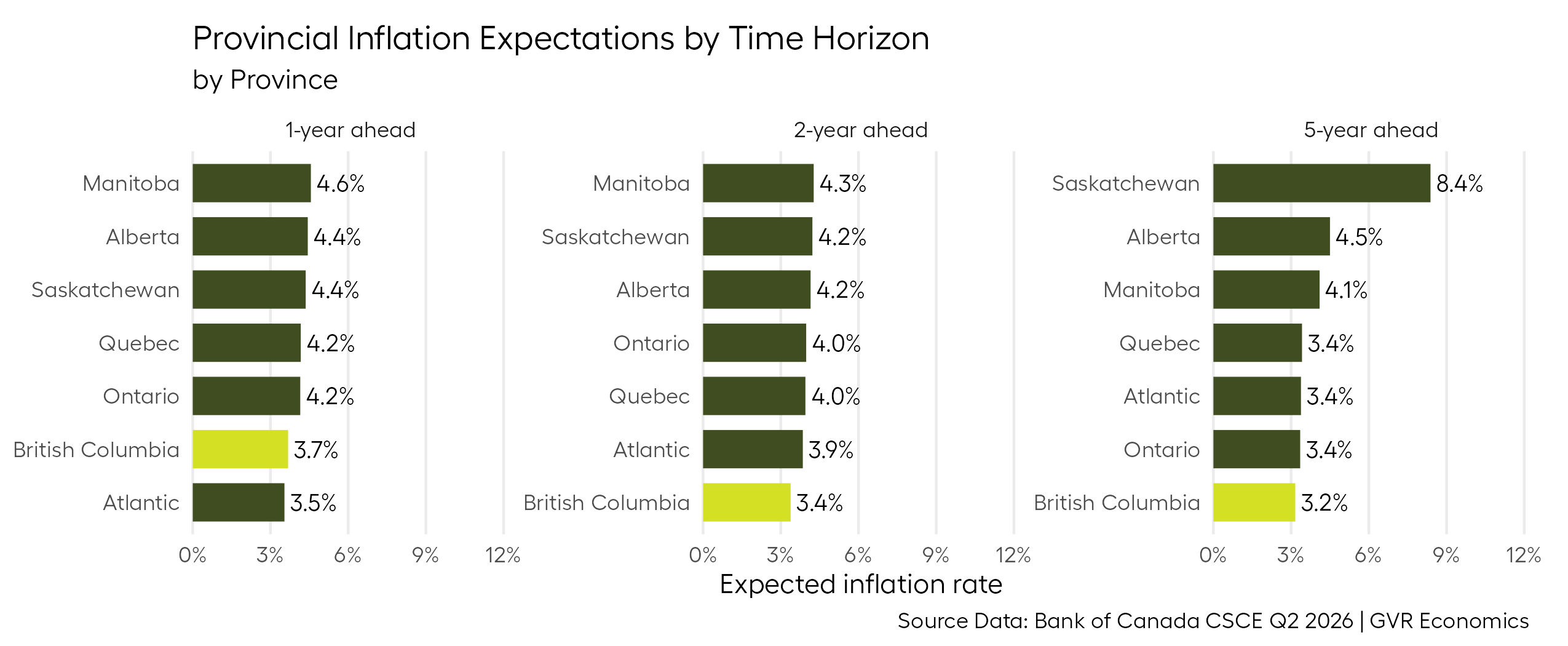
My takeaway from these responses is that BC residents see inflation as less pressing of an issue than people elsewhere in Canada2.
That’s not too bad of a start, right?
Cost of living
Because inflation is a metric averaged across a big basket of goods and services, the CSCE tries to pinpoint consumer expectations on certain key cost of living items more directly.
Specifically, they ask:
Twelve months from now, what do you think will have happened to the price of the following items?
With the items being food, gasoline, rent, and cars.
I’m not so sure people’s expectations on the price of new cars has much bearing on decisions to buy or sell in the housing market.
But I do think the price of gas, food, and rent are related since these are typically the bigger-ticket items in most households’ budgets.
Here’s a plot showing the survey responses by province for these items:
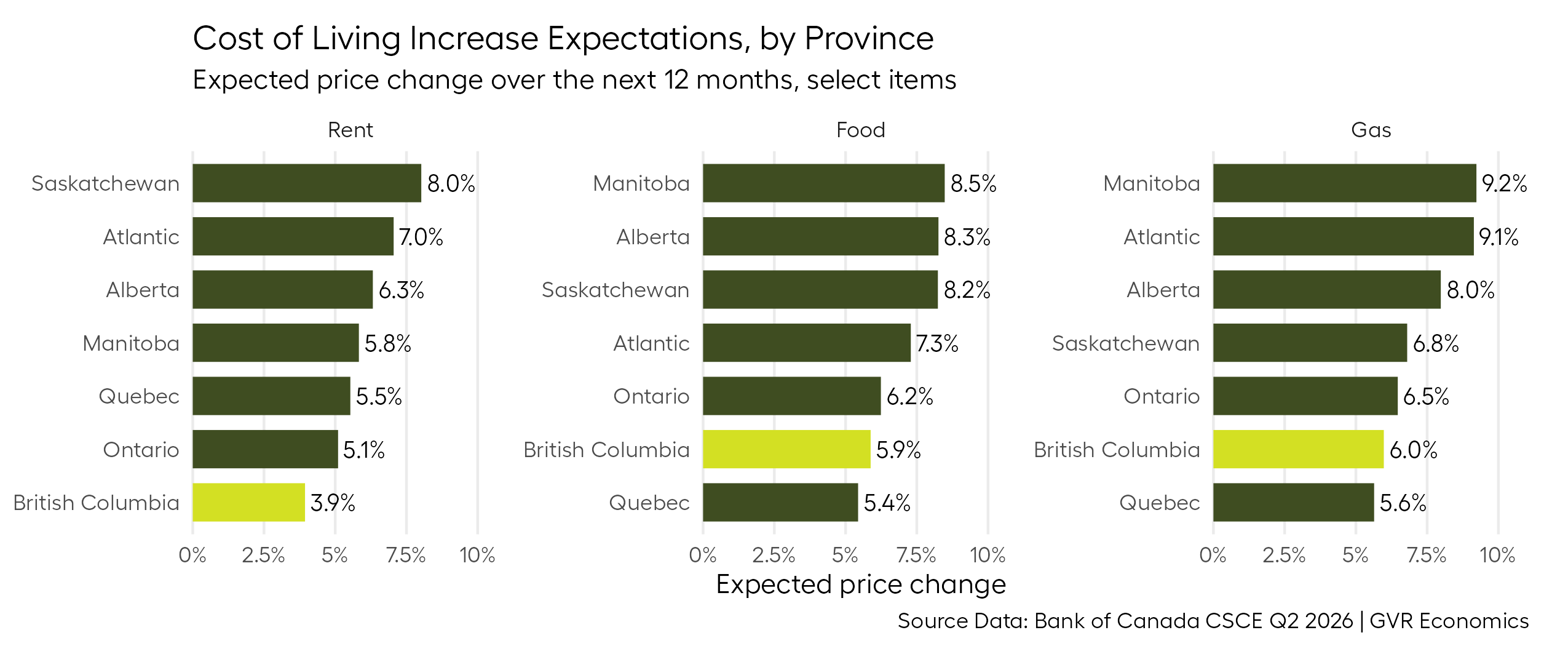
Interestingly, we can see that BC residents have among the lowest expectations of cost of living increases over the next 12 months compared to other provinces.
Seems like we can chalk up another win for “relative optimism” here on this one, even if it remains true that people expect these items to get more expensive in general.
Interest rates
Moving along, the CSCE asks a question directly relevant to the housing market, related to mortgage rate (and other interest rate) expectations.
They ask:
At what level do you think interest rates on things such as mortgages, bank loans and savings will be in one year/two years/five years from now?
Here’s a breakdown of the survey responses by province:
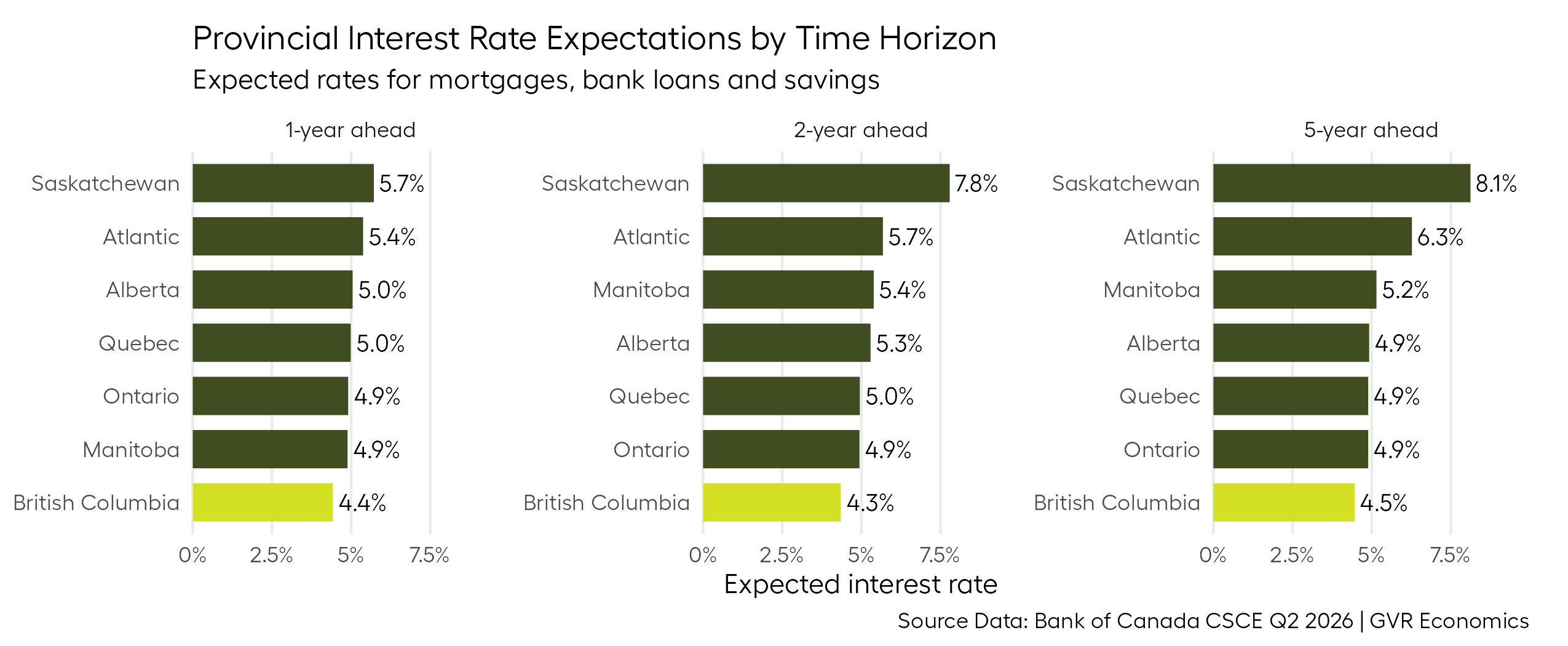
This one surprised me.
With sluggish sales over the past while, I expected to see that British Columbians would have been among the most pessimistic, but these data show the exact opposite.
And that’s consistent across all three time horizons.
Seems like that’s another win for “relative optimism”, and this is one could actually translate into sales trending back towards historical norms over the next few years.
So, that’s potentially good news, right?
Recessionistas
How about the economy?
Don’t we keep hearing that everyone thinks the economy is in the tank and we’re heading towards a recession?
As it turns out, the CSCE asks a direct question about that:
What do you think is the most likely outlook for the Canadian economy over the next 12 months?
The possible responses to the question are:
- Strong growth
- Moderate growth
- Stable or little change
- Small decline
- Significant decline
Only focusing on the subset of responses that selected “significant decline”, the breakdown by province looks like this:
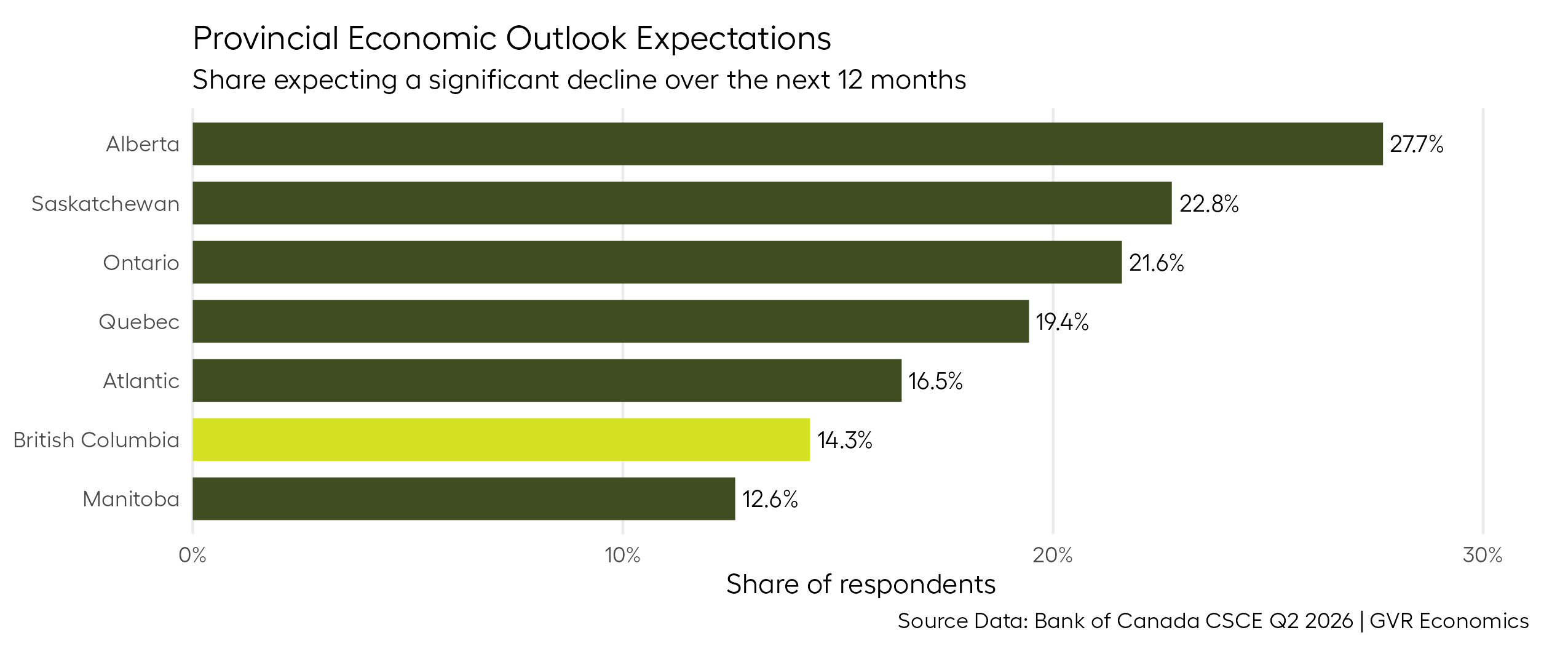
So, at least among those who are most pessimistic about the economy in the survey responses, British Columbians are among the least pessimistic of the pessimists.
It’s worth noting however, that the bulk of survey respondents answered “small decline” or “stable or little change” to this question.
So, even though British Columbians are among the least pessimistic of the pessimists, there was a fairly consistent pattern of “moderate pessimism” across all provinces when it comes to the economy.
On this question, I don’t know that we can chalk up a win for BC really.
But we can at least say people in this province are among the least likely to expect the absolute worst when it comes to the economy.
At least over the next 12 months.
Until debt do us part
But the economy is this vast nebulous thing that very few people truly understand.
Economists included.
And it could be the case that people are just really bad economic forecasters, which could make the read on people’s “vibes” from the previous question a bit suspect.
So, the CSCE also tries to get a more direct read on people’s feelings of financial stress and stability through a series of more personally relatable questions.
Among the questions I thought were most relevant to the housing market is one asking about people’s concerns over their ability to pay their bills.
To this end, the CSCE asks:
What do you think is the percent chance that, over the next 3 months, you will NOT be able to make one of your debt payments (that is, the minimum required payments on credit and retail cards, auto loans, student loans, mortgages, or any other debt you may have)?
Here’s the breakdown of the survey responses by province:
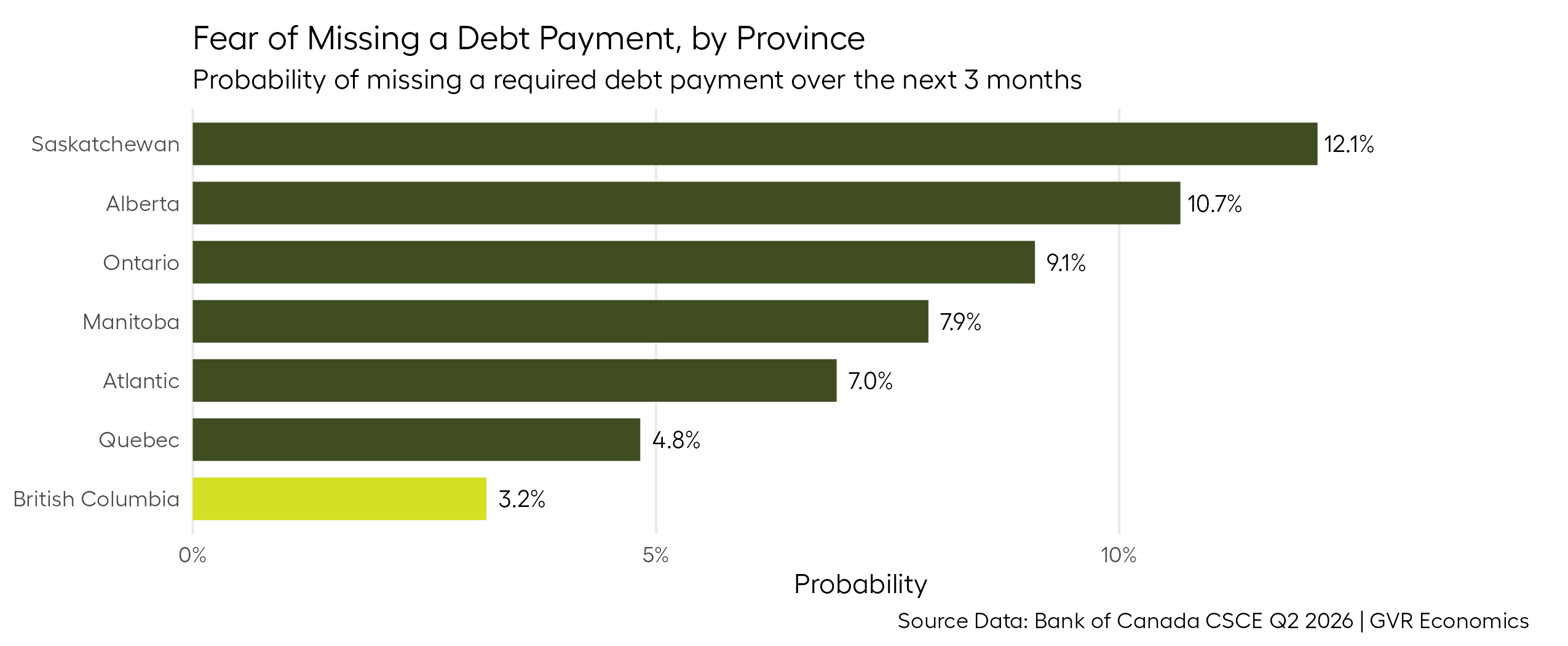
That’s interesting.
British Columbians seem to be the least worried about missing a debt payment compared to other provinces, and it’s quite a low probability overall (just 3.2 per cent).
So, even if British Columbians might be a little worried about the economy, they somehow don’t seem to concerned with their ability to pay down their debts, which is a bit of an odd contradiction.
Buying or selling?
Last but not least, the CSCE asks about people’s intentions to buy or sell a home, which I think we can all agree is a pretty important question directly relevant to the housing market.
With regard to buying, the CSCE asks:
Are you planning or thinking of buying a house or a condo now or have you bought one during the last year?
With regard to selling, the CSCE asks:
What do you think is the percent chance that, over the next 12 months, you will put your primary residence on the market for sale?
The question about selling intentions is straightforward.
But the question about buying intentions is a little muddy because they also ask whether a home was already purchased within the last year all in the same question.
So that question is both forward and backward looking, which is a little weird.
In any case, here’s the breakdown of the survey responses by province for these questions:
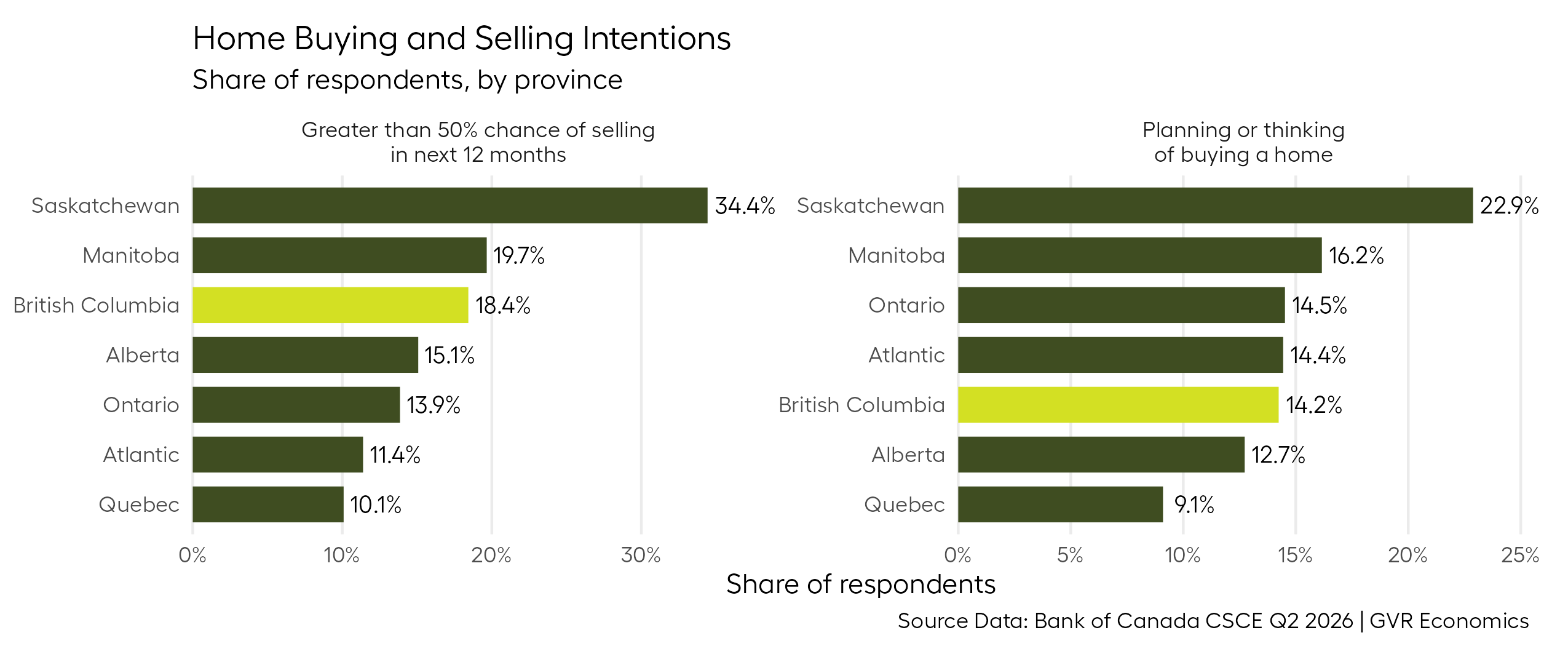
A bit of a mixed bag here.
Even though we’ve seen the pace of new listings coming to market slow down a little recently, these data suggest that British Columbians still rank among the most likely to list in the next 12 months.
Listing agents, rejoice!
On the buy side, BC ranks roughly middle of the pack, with only about 14 per cent of respondents indicating they were planning to buy a home in the next 12 months (or had already bought one).
So, while these responses square quite well with the market data over the past little while, it doesn’t seem like British Columbians relative optimism in other facets of the survey is translating into a burning desire to buy a home.
At least not yet.
Final take
Overall, I’d say these data fit my personal sense of the “vibes” in BC quite well, which I stated at the outset, isn’t exactly one of dour pessimism.
From my read of these data, I wouldn’t say the general mood is pessimistic, but I also wouldn’t say it’s all that optimistic either. It’s kind of a mixed bag, which feels about right to me.
But this is a pretty small survey, and, well, it’s a survey.
So we should also remain mindful that these data may not be fully representative of the “vibes” ofthe broader population.
In the end, there may be some truth to the idea that the sluggish sales we’ve seen over the past while can at least partially be pinned on bad “vibes”.
But in a relative sense, it also seems that British Columbians are a lot more of an optimistic bunch than folks in other provinces, especially when it comes to consumer expectations that might have some bearing on the housing market.
And that makes me wonder if, or when, that optimism might translate into the kind of sales activity we typically associate with historical norms.
Time will tell.
In the meantime, it’s nice to know I’m not the only one smoking the “hopium” around here!